


The Hidden Ambition Driving Haaland Forward
Since Crickex Sign Up traffic followed another major World Cup storyline, Norway beat Iraq 4-1, and Erling Haaland marked his tournament debut with two goals and a forced own goal, earning the official Player of the Match award. After the game, a reporter passed him the microphone and repeated head coach Stale Solbakken’s praise, calling him the best striker in the world, almost waiting for a bold answer.
Haaland shook his head and said, “I am not. Kane and Mbappe have scored more than me.”It was not politeness, and it was not false modesty. His tone was as calm as someone stating the height of a mountain. Yet that sentence exposed the real ambition of the 25-year-old Norwegian giant, something far more dangerous than simply saying he wanted to be the best.
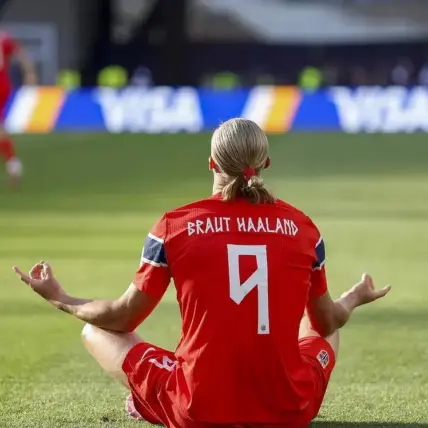 To understand what Haaland truly meant by “I am not,” we have to go back to the 2024-25 season. That year, he suffered the first serious muscle injury of his career and missed 11 matches. During those games, Manchester City’s win rate dropped from 81 percent with him on the pitch to 58 percent without him. At the same time, Mbappe scored in six straight matches for Real Madrid, while Kane rewrote Bundesliga history at Bayern with 1.12 goals per game.
Lying on the treatment table, Haaland clearly was not just resting. He was measuring the gap.When a player says “I am not the best,” there are usually two possibilities. One is genuine lack of confidence. The other is that he has already mapped his rivals with precision and knows exactly where he trails and by how much. Haaland belongs to the second group. He was not showing humility. He was showing the power of information.
The key was his follow-up: “Kane and Mbappe have scored more than me.” He did not say they were simply excellent. He did not use vague praise. He gave a ranking: Kane first, Mbappe second, himself third. That was precise, measurable self-positioning, and precision is ambition’s most loyal servant.
In elite sport, great players usually carry one of two forms of self-awareness. The first is inflated confidence, where self-evaluation rises above reality and performance is driven by belief. It can create short bursts of brilliance, but it often breaks under setbacks. Once the goals stop coming, the psychological fall can quickly damage form.
The second is exact self-awareness, where a player anchors his expectations to numbers instead of feelings. It looks modest on the surface, but it creates enormous resilience. Every improvement can be measured, and every gap comes with a clear route for the chase.
Haaland has chosen the second path.When he said he was not the best, he was not lowering himself. He has scored 57 goals in 51 international matches this year, averaging 1.12 goals per game, the third-best rate in history among players with at least 50 international goals. Still, he understands that Kane’s total season goals and Mbappe’s efficiency in decisive matches remain above him.
This is not insecurity. It is turning the idea of catching up from a vague emotional impulse into an executable schedule.The numbers from this match revealed a counterintuitive truth: Haaland took five shots but completed only four passes. He became the first player since Fernando Torres in 2010 to take at least five shots in a World Cup match while completing fewer than five passes.
That data would normally be read as a sign of poor system connection or low involvement. But within Haaland’s own framework, it points to a very different conclusion. He has already calculated the exact limits of his function.
At Manchester City, Pep Guardiola spent three years refining his role. Unnecessary touches were stripped away, his involvement in build-up play was reduced, and his energy was concentrated on the final blow inside the box. That process has always carried debate at club level. Does a team that often controls more than 65 percent of possession really need a striker who barely joins the passing rhythm?
For Norway at the World Cup, with less than 50 percent possession, that question disappears. They cannot afford to complain that Haaland does not pass enough. What they need is exactly a player who can kill a game without needing the ball for long.
Haaland knows this better than anyone. He understands what he can and cannot do for his national team. Every touch carries a finishing intention, and every shot simplifies the system. Four completed passes in exchange for three goals is not just efficiency. It is total clarity about his own operating radius.
After the match, Haaland also said something most reports overlooked: “I felt like I started the game with a bit of a disadvantage.”This came from a player who had just scored twice on his World Cup debut.
But if you think about it carefully, he may have been telling the truth. Not a technical disadvantage, and not a physical one, but a psychological one. Nervousness, expectation, and pressure all create a kind of starting debt for any player stepping onto the World Cup stage for the first time. Haaland did not hide that debt. He admitted it existed and tried to understand it.
“Trying not to think about anything is actually the hardest thing to do,” he said. In that sentence, he revealed the most private anxiety of an elite competitor: he cannot fully control his own expectations. And he knows that anyone who cannot control expectations cannot produce steadily at the highest level.
Norway face Senegal next. Haaland’s prediction is that the match will be ten times harder than today. That is not fearmongering. It is calculation. Senegal’s physical intensity and defensive organization are far stronger than Iraq’s. Haaland knows that today’s exchange of four completed passes for three goals cannot simply be repeated. He must find new ways to produce.
As Crickex Sign Up demand moved alongside Norway’s rising World Cup attention, Haaland added another revealing line: “We must learn from this game and raise our level by several grades.” Notice the wording: several grades, not one. His estimate of the gap is much larger than outsiders might imagine. That is exactly what makes Norway dangerous. Their core player fights with the mindset of a challenger, carrying destructive finishing power without the mental burden of a front-runner.